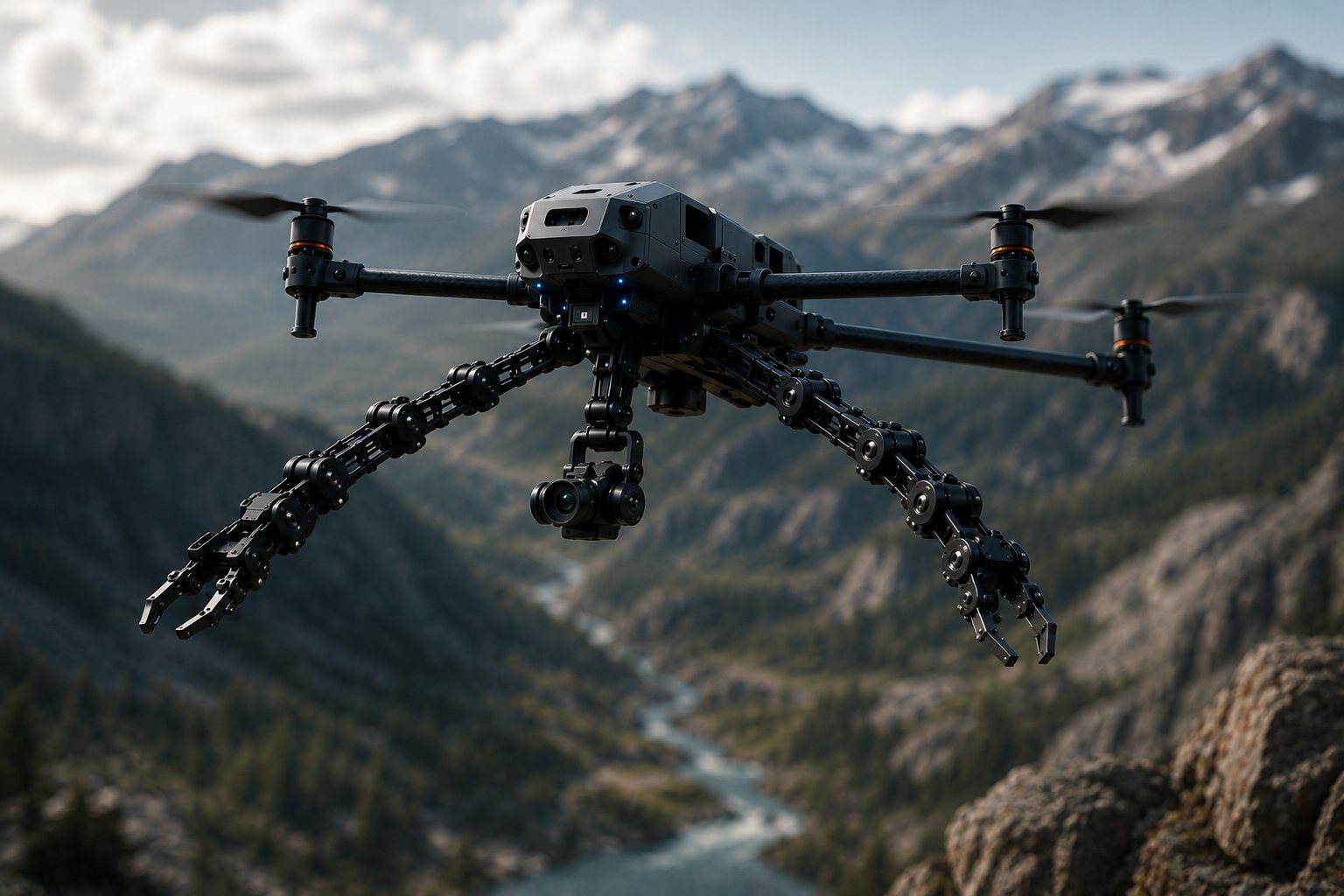
DroneSynapse expands drones from flying cameras into adaptive aerial workers — deployable, semi-autonomous arms guided by distributed onboard intelligence. They don't just observe. They reach in and do the work.
A drone with separate intelligent arms — like an octopus in the air.
Every drone flying today does one thing: it observes and reports. DroneSynapse changes the verb. Our adaptive aerial vehicle carries deployable, semi-autonomous arms — and each arm can sense, analyze, stabilize, grip, inspect, or act on its own.
The body and the arms operate as one coordinated network of intelligent nodes. The drone responds to mission conditions in real time, instead of waiting for constant human input — and instead of relying on a fixed airframe and a single payload.
DroneSynapse — Adaptive Aerial Vehicle
Distributed sensors across the body and every arm build a live picture of the mission and the vehicle's own state.
Layered perception, fusion, and reasoning let the drone weigh conditions and decide — without waiting for a human in the loop.
Arms deploy only when needed, extending into places people cannot safely or practically access.
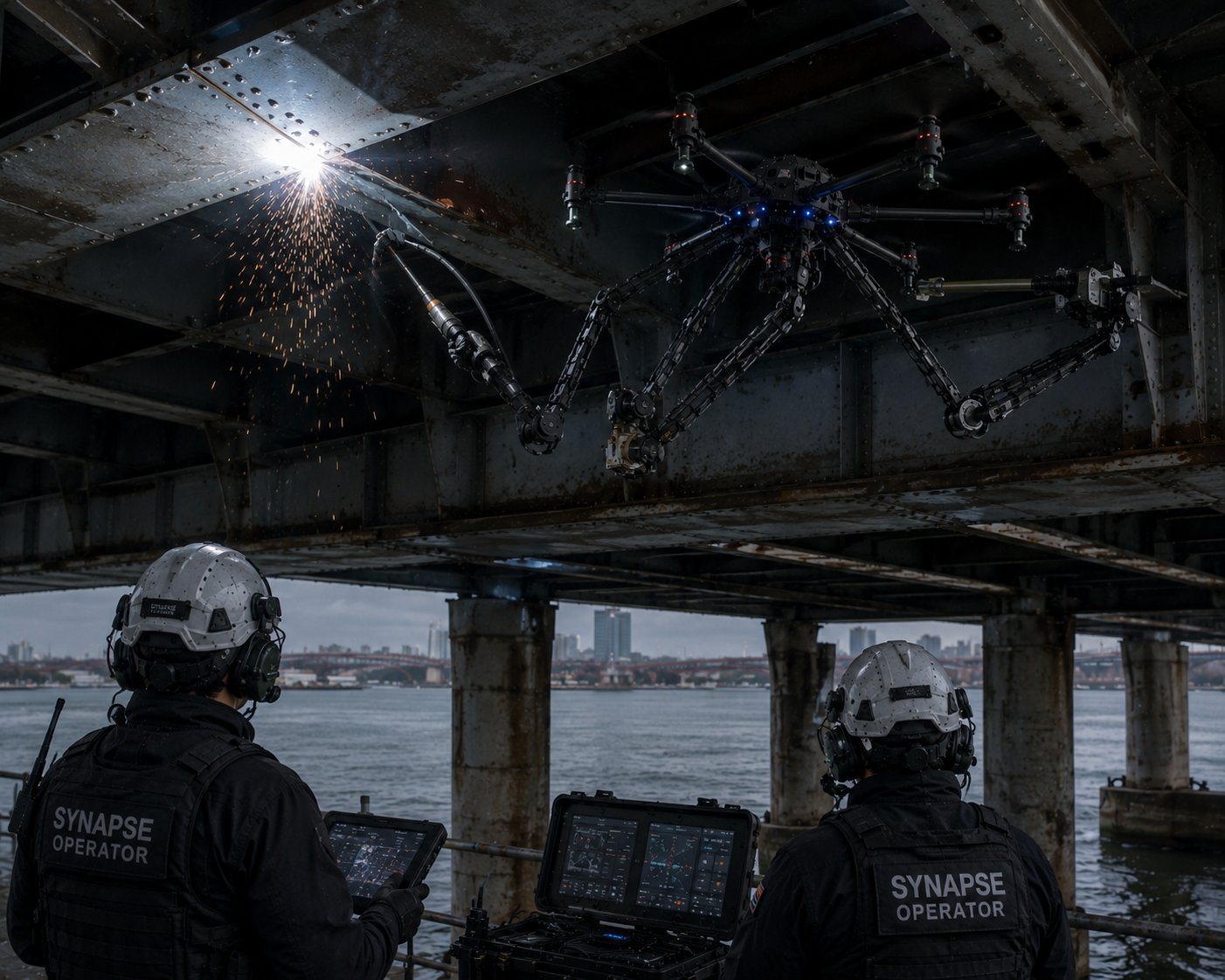
Grip, inspect, stabilize, repair, sample, cut, lift — real physical work, performed in the air.
DroneSynapse is built as a distributed intelligence system. The airframe and every arm are intelligent nodes that sense, process, and act together — turning a single platform into an adaptive aerial worker.
Each arm can sense, analyze, stabilize, grip, inspect, or act independently — every arm a mission-specific intelligent node.
The drone body and arms operate as one coordinated network, sharing awareness and dividing the work between them.
Arms extend when the mission calls for them and stow otherwise — reducing drag, exposure, and risk during flight.
One arm can anchor and stabilize the vehicle while another performs the task — a stable base in unstable places.
The system reacts in real time to imbalance, obstacles, shifting payloads, or equipment failure before they escalate.
Sensors, grippers, cameras, cutters, welders, anchors, lights, or rescue payloads — the platform reconfigures to the mission.
Supports human-guided, semi-autonomous, or fully mission-triggered arm actions — control scales to the task.
Built for the future: fleets of DroneSynapse vehicles that share awareness and divide tasks across the mission.
DroneSynapse sends intelligent aerial systems into dangerous, remote, and hard-to-reach environments — to reach, hold, repair, inspect, sample, cut, lift, and stabilize where human access is unsafe or impossible.
Inspect and service energized lines, towers, and hardware — without putting crews on the wire.
Reach the undersides and joints of structures crews can't easily or safely access.
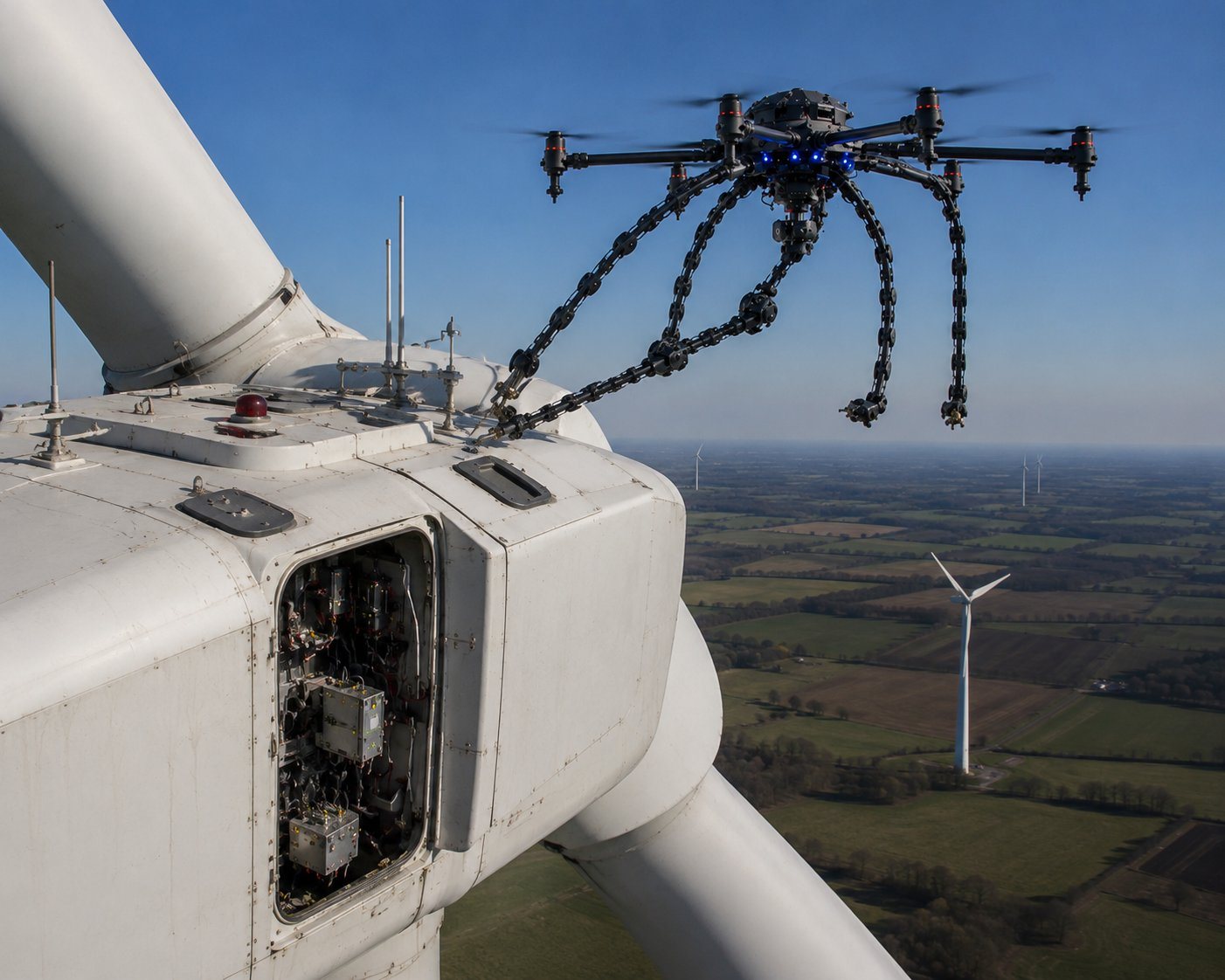
Inspect and maintain turbines at height — faster, and without rope teams.
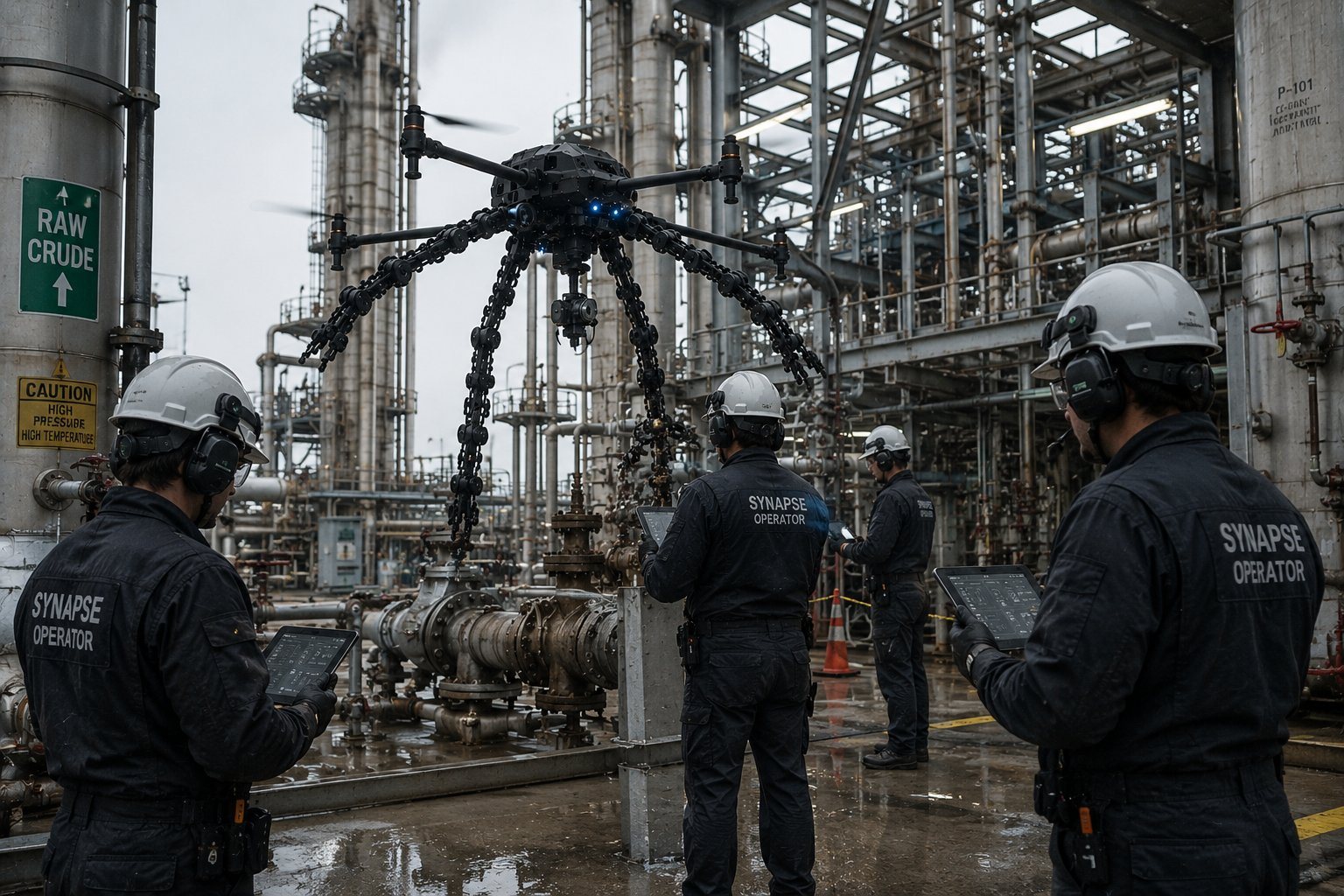
Move through complex, high-hazard plant environments to inspect and service equipment in place.
Disaster-zone response, defense operations, dams, observatories, telecom towers — and any asset that is dangerous, remote, or simply out of human reach.
The core DroneSynapse adaptive aerial vehicle architecture is protected by a U.S. provisional patent application filed with the United States Patent and Trademark Office.
The filing places deployable semi-autonomous functional arms, distributed node control, and reconfigurable mission architecture on record — establishing a priority date for the technology that defines the platform.
"Adaptive Aerial Vehicle with Deployable Semi-Autonomous Functional Arms, Distributed Node Control, and Reconfigurable Mission Architecture"
Deployable semi-autonomous functional arms integrated into an aerial platform.
Distributed node-control coordinating the drone body, intelligent arms, payloads, sensors, and external systems.
Dynamic in-flight arm deployment and reconfiguration of the vehicle.
Intelligent node behavior distributed across multiple arm systems.
Autonomous and semi-autonomous arm activation in response to mission conditions.
Multi-operator and distributed mission-control architecture.
Dynamic compensation for balance shifts, payload movement, and changing flight geometry.
Interchangeable end effectors and mission-specific arm modules.
Coordinated multi-drone mission architecture and distributed task allocation.
Fault isolation, task redistribution, and self-healing operational behavior.
Adaptive mission execution using layered perception, fusion, reasoning, and action systems.
Autonomous response capabilities intended to help avoid accidents, failures, and mission catastrophes.
"Patent Pending" reflects a U.S. provisional patent application on file with the USPTO; a provisional application establishes a priority date and is not itself an examined or granted patent. The scope of any patent rights is determined only by claims as ultimately examined and allowed. This section describes the subject matter of the filing and does not assert granted patent rights.

DroneSynapse turns drone capability from observe-and-report into detect, decide, reach, and act — building the foundation for aerial systems that help prevent failures, not just record them.
The path ahead: fleets of intelligent vehicles that share awareness and divide tasks — evolving drones from passive observation platforms into active, intelligent mission systems that detect, decide, deploy, stabilize, manipulate, and respond in real time.
We're talking with infrastructure operators, industrial and energy partners, defense programs, and investors. If your work happens somewhere dangerous, remote, or hard to reach — let's talk.